Introduction
Blow Fill Seal technology has become one of the most important innovations in sterile pharmaceutical manufacturing. Designed to integrate container creation, liquid filling, and sealing into a single continuous process, this method significantly improves product safety, efficiency, and consistency. In an industry where sterility is non-negotiable, Blow Fill Seal offers a controlled solution that minimizes contamination risks while supporting high-volume production. Understanding how this technology works and why it is widely adopted provides valuable insight into modern medication delivery systems.
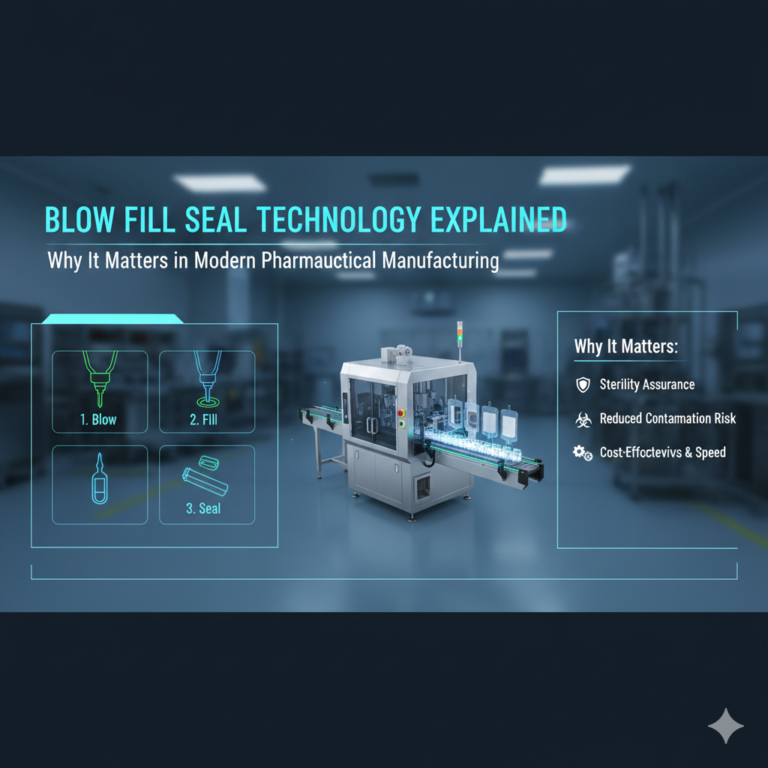
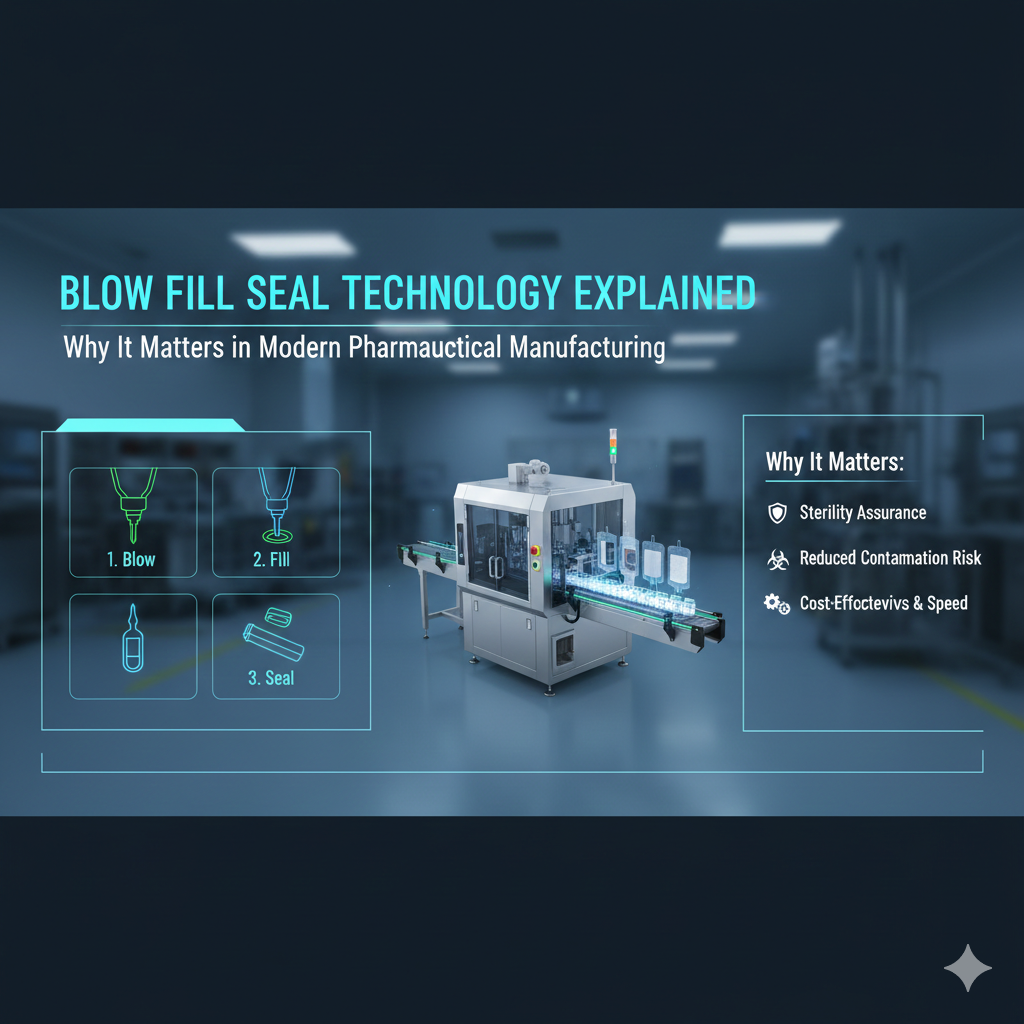
Blow Fill Seal is fundamentally an aseptic manufacturing process. Instead of forming containers separately and then transporting them for filling, the technology creates packaging and fills it within an enclosed sterile environment. Pharmaceutical-grade resin is heated until it becomes molten and then extruded into a tube-like form. This material is captured inside a mold where it is shaped into a container. Immediately after formation, the liquid drug product is introduced into the container, and the unit is sealed before leaving the sterile chamber.
This seamless integration is the defining advantage of the technology. Traditional manufacturing processes involve multiple stages, including container production, sterilization, transportation, filling, and sealing. Each step introduces opportunities for contamination, variability, and mechanical complexity. Blow Fill Seal consolidates these operations into one automated sequence, drastically reducing human intervention. The absence of direct handling enhances sterility assurance and improves overall manufacturing reliability.
One of the most critical benefits of Blow Fill Seal technology is contamination control. Sterile liquid medications are particularly vulnerable during filling and packaging. Microbial contamination, particulate intrusion, or environmental exposure can compromise product safety. Because BFS systems operate within a closed sterile environment, the process significantly lowers these risks. Automation ensures consistent replication of container formation and filling parameters, supporting both safety and precision.
Efficiency is another major advantage. By eliminating separate container sterilization and handling stages, BFS reduces production time and operational complexity. The integrated system allows manufacturers to achieve high throughput without sacrificing quality. This efficiency becomes especially valuable when producing medications that require large-scale distribution, such as respiratory therapies or ophthalmic solutions. Faster production cycles contribute to supply stability, which is essential in healthcare environments.
Blow Fill Seal packaging is also uniquely suited for unit-dose applications. Single-dose containers provide multiple clinical and practical benefits. They reduce the need for preservatives, minimize cross-contamination risk, and improve dosing accuracy. Patients and healthcare providers benefit from convenient, ready-to-use packaging that enhances safety and ease of administration. Lightweight plastic containers are shatter-resistant and portable, making them ideal for a variety of treatment settings.
Despite its advantages, Blow Fill Seal technology demands sophisticated engineering and strict quality controls. Precision in temperature regulation, mold design, filling accuracy, and sealing integrity is essential. Minor deviations can influence container consistency or product stability. Manufacturers utilizing BFS systems invest heavily in validation, monitoring, and regulatory compliance to maintain performance standards.
Within this landscape, specialized manufacturers play a vital role. Organizations dedicated to BFS technology develop deep expertise in formulation compatibility, container design, and aseptic process control. Their knowledge allows pharmaceutical partners to leverage the technology effectively while maintaining regulatory alignment. The integration of development and manufacturing capabilities supports faster transitions from product design to commercial production.
Blow Fill Seal technology has also contributed to broader advancements in pharmaceutical safety and accessibility. The ability to produce sterile medications efficiently and at scale supports healthcare systems worldwide. Reliable unit-dose packaging improves patient safety, particularly in treatments requiring precise administration. As demand for sterile liquid therapies continues to grow, BFS remains a cornerstone of modern drug delivery strategies.
In practical terms, the technology represents more than a manufacturing improvement. It reflects a shift toward integrated, contamination-resistant production systems designed to meet increasingly rigorous safety expectations. By combining automation, sterility, and efficiency, Blow Fill Seal has redefined how liquid medications are packaged and delivered.
In summary, Blow Fill Seal technology stands as a critical innovation in pharmaceutical manufacturing. Its ability to integrate container formation, filling, and sealing within a sterile environment enhances product safety while supporting operational efficiency. From contamination control to unit-dose convenience, the advantages extend across the entire medication lifecycle. As pharmaceutical technologies continue to evolve, BFS remains a defining solution for sterile liquid drug production.
FAQs
What is Blow Fill Seal technology
Blow Fill Seal is an aseptic manufacturing process that forms plastic containers, fills them with liquid medication, and seals them in a single automated sequence within a sterile environment.
Why is Blow Fill Seal considered safer than traditional filling methods
Because the entire process occurs inside a closed sterile system with minimal human intervention, the risk of contamination is significantly reduced.
What types of medications commonly use Blow Fill Seal packaging
Blow Fill Seal is widely used for sterile liquid products such as respiratory therapies, ophthalmic solutions, otic medications, and other unit-dose formulations.
Does Blow Fill Seal eliminate the need for preservatives
Unit-dose packaging produced through BFS often reduces or eliminates the need for preservatives by minimizing repeated exposure to external contaminants.
Why do pharmaceutical companies choose Blow Fill Seal manufacturing
Manufacturers value BFS for its sterility assurance, production efficiency, packaging consistency, and suitability for high-volume unit-dose applications.
About the Author